Press release from "Aquinas and More", sponsor of the "Catholic Summer Reading Program"
MEDIA ADVISORY
Colorado Springs, Colorado (MAY 13, 2009) -
This summer, why not take some time to discover the rich treasure of Catholic literature?
Aquinas and More Catholic Goods, the official sponsor of the Catholic Summer Reading Program (www.catholicsummerreading.com), would like to invite you to join in a book discussion at your school, parish, local Catholic store, or online at www.tiberriver.com - the all new Catholic book review and discussion website.
Designed to encourage continued reading about the Faith during the summer vacation months, the Catholic Summer Reading Program, now in its 3rd year, includes online discussion guides so you can form your own discussion group. Kids can also get involved by downloading the Catholic Kids Reading Path and filling it in as they read Catholic books during the summer.
Titles for this year’s program include: The Angels and Their Missions, Confessions of St. Augustine, The End of the Present World, King Lear, and many more.
Visit www.catholicsummerreading.com for more information.
Tuesday, May 26, 2009

Wednesday, March 25, 2009
Writings of Charles de Koninck
We've scanned and edited several lectures, articles, and other writings of Charles De Koninck, and added them here to the site, under the category of philosophy. We've also added a De Koninck Wiki for collaborative work on the archive of de Koninck's personal files: noting items of importance, proofing scanned versions of texts obtained by computer OCR, transcribing handwritten notes, etc.
Sunday, March 8, 2009
On the Inerrancy of Scripture
In 2008 the Synod of Bishops met to discuss the Word of God. The working document Instrument Laboris, which claimed as a certainty that "with regards to what might be inspired in the many parts of Sacred Scripture, inerrancy applies only to 'that truth which God wanted put into sacred writings for the sake of salvation' (DV 11)", was debated in Catholic and Christian circles. The bishops decided to pass the question on to the Congregation for the Doctrine of the Faith:
On this topic, the thesis On the Inerrancy of Scripture by Br. Thomas Bolin is now on the website.
Sections of the work
Introduction
The Rule of Faith Proven by Authority
The Rule of Faith Considered by Reason
Epilogue
Proposition 12: Inspiration and truth in the Bible
The synod proposes that the Congregation for the Doctrine of the Faith clarify the concepts of “inspiration” and “truth” in the Bible, along with their reciprocal relationship, in order to better understand the teaching of Dei Verbum 11. In particular, it’s necessary to emphasize the specific character of Catholic Biblical hermeneutics in this area.
On this topic, the thesis On the Inerrancy of Scripture by Br. Thomas Bolin is now on the website.
Sections of the work
Introduction
The Rule of Faith Proven by Authority
The Rule of Faith Considered by Reason
Epilogue
Saturday, March 7, 2009
Evolution and Creation
Cardinal Schönborn gave a lecture on March 4 to the Austrian Academy of Sciences on "Creation and Evolution - two paradigms and their mutual relationship", in which he both calls radical creationism "absurd", and distinguishes the Catholic Church's understanding of creation from that of creationism.
I've translated one section of the lecture here. The full text can be found in German here.
My attempt this evening will be, in (as an amateur but with the greatest interest) listening to the works of the natural sciences, to articulate the contribution of theology.
In this three questions are of particular importance.
1. A more philosophical preliminary question: Why does “nature” give us answers? Why is it “legible?” Why can it be deciphered, decoded?
2. What does classical theology understand by “creation?” And what are the most common misunderstanding concerning the concept of creation?
3. Are the viewpoint of faith concerning creation and the approach of natural science to the development of life compatible?
...
As we saw, Darwin wrestled with “his” theology of creation, and finally parted ways from it, since it seemed to him to be incompatible with his scientific knowledge. In great intellectual and human honesty he accepted no “double” truth, a scientific-rational and a religious-emotional truth. He made a choice, and his choice followed the insights that pushed upon him as certainty.
Darwin began the study of theology in 1828 in Cambridge. I could not pursue the question of what he heard and read, what kind of theology he learned. He was likely not a very diligent student of theology. His real interest certainly lay elsewhere. My impression is that his theological understanding of creation was not at a high level of reflection. For him there was no question that a literal understanding of the six days of creation was incompatible with the most elementary knowledge of the earth's history. Or was it? Certainly, as we saw, he had great trouble with the view that God had created the individual species. Exactly that he was able to, wanted to refute with his theory.
But how did Darwin see creation? How did he understand God's creative action? How it was not to be understood, he shows in a quite sarcastic tone in the “Origin of Species”
No, the idea of the creation of completed individual beings or species is absurd. It is as just as unsustainable as the creationist theses of a creation of the world in six 24-hour days, as the pseudo-scientific speculations about a “young” earth, about a historical interpretation of the Flood, etc.
But it is equally an inadmissible simplification, to lump the scriptural-fundamentalist creationism together with a sound belief in creation, as is often done. The scriptural understanding of creationism is certainly not that of the Catholic Church and that of the great Christian intellectual tradition.
Yet the understanding of creation against which Darwin unfolds the “long argument” of his theory is much closer to that of fundamentalist creationism than to that of the great Christian philosophical and theological thought on the theme of creation. My suspicion is that in his quite brief study of theology he scarcely tackled the Christian masters. He read William Paley, his “The Evidence of Christianity,” but in this very apologetic approach to Christianity he hardly found the great Christian intellectual tradition, but rather a strongly pragmatic approach, as the Anglo-Saxon culture preferred, and above all “deism,” which admits a Creator merely a clockmaker at the beginning.
At this point a look back in the field of humanities is necessary. Since the late middle ages, the stream of nominalism brought about an ever clearer mechanization of the world-view. Ever more all causality was reduced to material causality. The classic teaching on the four causes was lost, especially final causality and formal causality. As Werner Heisenberg established, the concept of the four causes became limited to the material and efficient cause, to “the rule of cause and effect”; this limitation reduction ever more the perception of truth to the material.
In this reductionistic understanding of reality there are only extrinsic causes working “from without.” It is striking that in Darwin's criticism of individual acts of creation these causes are understood entirely as material causes (and thus rightfully rejected). God appears as one cause among other material causes that are “within the world.” But that can not be the meaning of “creation.” If the concept of creation is to have meaning, it cannot be as one cause among others in the chain of efficient causes.
As I see it, the mistake of the “Intelligent Design” school of thought (with which people always wrongly associate me). The attempt of this school to assess high complexity in nature as evidence or proof of “intelligent design” suffers from the fundamental failure in thought, that “design,” plan, directedness to an end cannot be found on the level of causality with which the scientific method (in natural science) is concerned.
I am convinced that an origin and an end, and thus something that one could call “intelligent design” may be recognized in creation. For me it is a sensible, reasonable point of view to conclude to a creator. But it is not a scientific point of view. I do not expect scientific research to prove God to me. It can do that just as little as it can prove the opposite. Neither lays within the horizon of its method. But the scientist as a man, who thinks about nature, who asks himself the questions of the “from where,” “to where,” and “what for” of the world and of his life, can indeed come to the conclusion that the acceptance of a creator is a more sensible and reasonable point of view than the radical nihilism of Friedrich Nietzsche.
When the scientist or the lay person interested in science asks the question about the creation, he has above all the difficulty that we can imagine change, but not creation. We cannot picture the evolution of life in all its particulars, because we cannot reconstruct the whole. But we all have a view of development, indeed we can to some extent active replicate it (just think about technical developments). But in every case it is something already present that develops. Creation in the theological sense, however, means that divine activity, through which there is anything at all, through which the world comes into being.
We approach creation when we ask ourselves in wonder: Why does the world exist? Why do we exist, why do I? Was there a meaning that we came into existence? The research of evolution can only ask how the forms of life developed. But why we are here, what the goal of our existence is, no science can answer. When it claims to do that, it leaves the field of its scientificness and becomes an ideology. To make a clean distinction here seems to me to be decisively important for the future. One could abuse Darwin's theory of genealogy in an ideological manner for racism or eugenics, for communism or turbo-capitalism. Hence a critique of Darwinism from the viewpoint of ideology is so important, especially by a clear distinction between the scientific theory and its improper expansion. Many things could be said here on the themes of social biology, evolutionary epistemology and ethics, to name just a few examples. What is most important is to avoid a reduction of the spiritual, ethical, culture and religious realms to the level of purely material causality. We will be able to explain neither the creator nor reason, neither knowledge nor ethics purely scientifically. But we have learned an enormous amount over the evolutionary environments of reason and will, ethics and religion. The evolution of life made all this possible, but it is not the ultimate basis for it. Spirit, will, and freedom cannot be solely the product of material evolution; otherwise they could not to a certain degree emancipate themselves from it, and to some degree take the initiative for their own cultural development, with the full responsibility that is connected with that. Responsibility – to whom? To the future generations! But also to ourselves, to the success of our own lives. And to the creator! There is responsibility only where to is someone to whom we own an answer. And that can only be to someone whom we can become aware of, whom we can understand, who speaks to our reason. Where instinct determines everything, there is no responsibility.
I've translated one section of the lecture here. The full text can be found in German here.
My attempt this evening will be, in (as an amateur but with the greatest interest) listening to the works of the natural sciences, to articulate the contribution of theology.
In this three questions are of particular importance.
1. A more philosophical preliminary question: Why does “nature” give us answers? Why is it “legible?” Why can it be deciphered, decoded?
2. What does classical theology understand by “creation?” And what are the most common misunderstanding concerning the concept of creation?
3. Are the viewpoint of faith concerning creation and the approach of natural science to the development of life compatible?
...
Notes on the Theology of Creation
Here we must begin a more exact presentation of what the great Christian teaching tradition understands by “creation.” Time is too short, but it is necessary to note at least a few key points.As we saw, Darwin wrestled with “his” theology of creation, and finally parted ways from it, since it seemed to him to be incompatible with his scientific knowledge. In great intellectual and human honesty he accepted no “double” truth, a scientific-rational and a religious-emotional truth. He made a choice, and his choice followed the insights that pushed upon him as certainty.
Darwin began the study of theology in 1828 in Cambridge. I could not pursue the question of what he heard and read, what kind of theology he learned. He was likely not a very diligent student of theology. His real interest certainly lay elsewhere. My impression is that his theological understanding of creation was not at a high level of reflection. For him there was no question that a literal understanding of the six days of creation was incompatible with the most elementary knowledge of the earth's history. Or was it? Certainly, as we saw, he had great trouble with the view that God had created the individual species. Exactly that he was able to, wanted to refute with his theory.
But how did Darwin see creation? How did he understand God's creative action? How it was not to be understood, he shows in a quite sarcastic tone in the “Origin of Species”
Do they [the representatives of individual acts of creation] really believe that at innumerable periods in the earth's history certain elemental atoms have been commanded suddenly to flash into living tissues? Do they believe that at each supposed act of creation one individual or many were produced? Were all the infinitely numerous kinds of animals and plants created as eggs or seed, or as full grown?
No, the idea of the creation of completed individual beings or species is absurd. It is as just as unsustainable as the creationist theses of a creation of the world in six 24-hour days, as the pseudo-scientific speculations about a “young” earth, about a historical interpretation of the Flood, etc.
But it is equally an inadmissible simplification, to lump the scriptural-fundamentalist creationism together with a sound belief in creation, as is often done. The scriptural understanding of creationism is certainly not that of the Catholic Church and that of the great Christian intellectual tradition.
Yet the understanding of creation against which Darwin unfolds the “long argument” of his theory is much closer to that of fundamentalist creationism than to that of the great Christian philosophical and theological thought on the theme of creation. My suspicion is that in his quite brief study of theology he scarcely tackled the Christian masters. He read William Paley, his “The Evidence of Christianity,” but in this very apologetic approach to Christianity he hardly found the great Christian intellectual tradition, but rather a strongly pragmatic approach, as the Anglo-Saxon culture preferred, and above all “deism,” which admits a Creator merely a clockmaker at the beginning.
At this point a look back in the field of humanities is necessary. Since the late middle ages, the stream of nominalism brought about an ever clearer mechanization of the world-view. Ever more all causality was reduced to material causality. The classic teaching on the four causes was lost, especially final causality and formal causality. As Werner Heisenberg established, the concept of the four causes became limited to the material and efficient cause, to “the rule of cause and effect”; this limitation reduction ever more the perception of truth to the material.
In this reductionistic understanding of reality there are only extrinsic causes working “from without.” It is striking that in Darwin's criticism of individual acts of creation these causes are understood entirely as material causes (and thus rightfully rejected). God appears as one cause among other material causes that are “within the world.” But that can not be the meaning of “creation.” If the concept of creation is to have meaning, it cannot be as one cause among others in the chain of efficient causes.
As I see it, the mistake of the “Intelligent Design” school of thought (with which people always wrongly associate me). The attempt of this school to assess high complexity in nature as evidence or proof of “intelligent design” suffers from the fundamental failure in thought, that “design,” plan, directedness to an end cannot be found on the level of causality with which the scientific method (in natural science) is concerned.
I am convinced that an origin and an end, and thus something that one could call “intelligent design” may be recognized in creation. For me it is a sensible, reasonable point of view to conclude to a creator. But it is not a scientific point of view. I do not expect scientific research to prove God to me. It can do that just as little as it can prove the opposite. Neither lays within the horizon of its method. But the scientist as a man, who thinks about nature, who asks himself the questions of the “from where,” “to where,” and “what for” of the world and of his life, can indeed come to the conclusion that the acceptance of a creator is a more sensible and reasonable point of view than the radical nihilism of Friedrich Nietzsche.
When the scientist or the lay person interested in science asks the question about the creation, he has above all the difficulty that we can imagine change, but not creation. We cannot picture the evolution of life in all its particulars, because we cannot reconstruct the whole. But we all have a view of development, indeed we can to some extent active replicate it (just think about technical developments). But in every case it is something already present that develops. Creation in the theological sense, however, means that divine activity, through which there is anything at all, through which the world comes into being.
We approach creation when we ask ourselves in wonder: Why does the world exist? Why do we exist, why do I? Was there a meaning that we came into existence? The research of evolution can only ask how the forms of life developed. But why we are here, what the goal of our existence is, no science can answer. When it claims to do that, it leaves the field of its scientificness and becomes an ideology. To make a clean distinction here seems to me to be decisively important for the future. One could abuse Darwin's theory of genealogy in an ideological manner for racism or eugenics, for communism or turbo-capitalism. Hence a critique of Darwinism from the viewpoint of ideology is so important, especially by a clear distinction between the scientific theory and its improper expansion. Many things could be said here on the themes of social biology, evolutionary epistemology and ethics, to name just a few examples. What is most important is to avoid a reduction of the spiritual, ethical, culture and religious realms to the level of purely material causality. We will be able to explain neither the creator nor reason, neither knowledge nor ethics purely scientifically. But we have learned an enormous amount over the evolutionary environments of reason and will, ethics and religion. The evolution of life made all this possible, but it is not the ultimate basis for it. Spirit, will, and freedom cannot be solely the product of material evolution; otherwise they could not to a certain degree emancipate themselves from it, and to some degree take the initiative for their own cultural development, with the full responsibility that is connected with that. Responsibility – to whom? To the future generations! But also to ourselves, to the success of our own lives. And to the creator! There is responsibility only where to is someone to whom we own an answer. And that can only be to someone whom we can become aware of, whom we can understand, who speaks to our reason. Where instinct determines everything, there is no responsibility.
Saturday, December 27, 2008
Reception of the Eucharist
I was reminded recently of the prevailing ignorance of liturgical symbolism, and the relation of the liturgical rubrics to this symbolism, by an argument I had recently with a priest, who was defending the practice of those who receive communion coming up and taking the chalice from the altar, after having received the Sacred Body from the priest, as well as the practice of handing the chalice from one person to another.
Both of these practices are explicitly forbidden by the General Instruction of the Roman Missal, as well as by the document on practices and abuses in the Liturgy, Redemptionis Sacramentum.
"The faithful are not permitted to take the consecrated bread or the sacred chalice by themselves, and, still less, to hand them from one to another" (General Instruction of the Roman Missal, n. 160; Cf. Redemptionis Sacramentum, n. 94).
General Instruction of the Roman Missal
Redemptionis Sacramentum: On certain matters to be observed or to be avoided regarding the Most Holy Eucharist
The reason for the practice is a simple one. The priest represents Christ giving his Body and Blood to his Mystical Body, the Church, to the faithful who receive it. The faithful are in the position of recipients: they receive Christ's Body and Blood from Christ, and this should be represented also in the form by which they receive.
Tuesday, December 9, 2008
Spoof of anti-religious advertisment

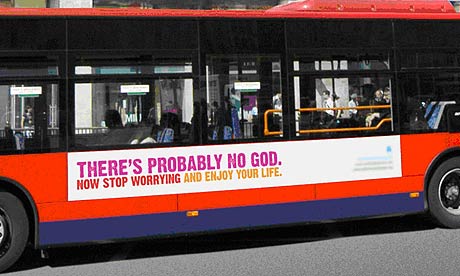
This photo was a response (thanks to Ignatius Insight) to the anti-religious advertisement campaign developed in London, with ads reading "There's probably no God. Now stop worrying and enjoy your life."
It is taken for granted, of course, by the original ad, that the existence of God is a cause for worry rather than peace and happiness. A propos of this, see these reflections on Paul's teaching on predestination as a cause of joy in St. Paul.
Free Catholic Books Search Engine
This site mostly aims to make available Catholic books, or notes and reviews on Catholic books that are not available elsewhere. But naturally, some people come to this site looking for certain particular Catholic books that are not available on this site--recently, for example, someone came looking for children's books and missals. To help with this, we've added a custom engine to search for free catholic books. We plan to add a second search that will include both free Catholic books and books that are only available for purchase.
Subscribe to:
Posts (Atom)