I was reminded recently of the prevailing ignorance of liturgical symbolism, and the relation of the liturgical rubrics to this symbolism, by an argument I had recently with a priest, who was defending the practice of those who receive communion coming up and taking the chalice from the altar, after having received the Sacred Body from the priest, as well as the practice of handing the chalice from one person to another.
Both of these practices are explicitly forbidden by the General Instruction of the Roman Missal, as well as by the document on practices and abuses in the Liturgy, Redemptionis Sacramentum.
"The faithful are not permitted to take the consecrated bread or the sacred chalice by themselves, and, still less, to hand them from one to another" (General Instruction of the Roman Missal, n. 160; Cf. Redemptionis Sacramentum, n. 94).
General Instruction of the Roman Missal
Redemptionis Sacramentum: On certain matters to be observed or to be avoided regarding the Most Holy Eucharist
The reason for the practice is a simple one. The priest represents Christ giving his Body and Blood to his Mystical Body, the Church, to the faithful who receive it. The faithful are in the position of recipients: they receive Christ's Body and Blood from Christ, and this should be represented also in the form by which they receive.
Saturday, December 27, 2008

Tuesday, December 9, 2008
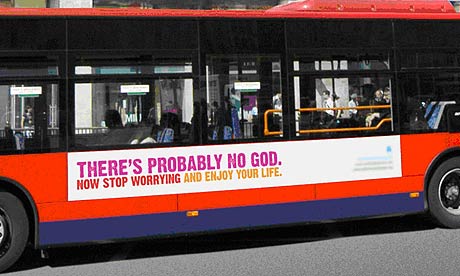
Spoof of anti-religious advertisment

This photo was a response (thanks to Ignatius Insight) to the anti-religious advertisement campaign developed in London, with ads reading "There's probably no God. Now stop worrying and enjoy your life."
It is taken for granted, of course, by the original ad, that the existence of God is a cause for worry rather than peace and happiness. A propos of this, see these reflections on Paul's teaching on predestination as a cause of joy in St. Paul.
Free Catholic Books Search Engine
This site mostly aims to make available Catholic books, or notes and reviews on Catholic books that are not available elsewhere. But naturally, some people come to this site looking for certain particular Catholic books that are not available on this site--recently, for example, someone came looking for children's books and missals. To help with this, we've added a custom engine to search for free catholic books. We plan to add a second search that will include both free Catholic books and books that are only available for purchase.
Sunday, September 28, 2008
Chesterton and Soloviev
Two new books are now available here on this site: Orthodoxy by G. K. Chesterton, and A Short Tale of The Anti-Christ by Vladimir Soloviev. Thanks for the suggestions. (Update: a few mistakes in Soloviev's work have been corrected; the Tale of the Anti-Christ also has shown a remarkable popularity--I would not have expected so many were looking for this book.)
Thursday, September 18, 2008
My vocation is Love!
"At last I have found my vocation, my vocation is Love!... In the heart of the Church, I will be Love!"
Is this discovery of St. Thérèse simply the common vocation of all of us, or has St. Thérèse found her own special vocation? Or are both true? Is it both her special vocation and the common vocation of us all? This essay on the words "My Vocation is Love" argues that it is both: the special vocation of St. Thérèse consists in giving herself entirely to that which is our common vocation--to live in love.
Is this discovery of St. Thérèse simply the common vocation of all of us, or has St. Thérèse found her own special vocation? Or are both true? Is it both her special vocation and the common vocation of us all? This essay on the words "My Vocation is Love" argues that it is both: the special vocation of St. Thérèse consists in giving herself entirely to that which is our common vocation--to live in love.
Wednesday, September 17, 2008
Feast of St. Robert Bellarmine
From St. Robert Bellarmine's The Ascent of the Mind to God:
"O Lord, sweet and gentle and full of mercy," who, beginning to taste even a little bit of the sweetness of your fatherly rule, would not serve you with their whole heart? What do you command your servants, Lord? "Take my yoke upon you," you say. And what kind of yoke is yours? "My yoke," you say, "is sweet, and my burden light." Who would not most gladly beat that yoke which does not discourage, but nourishes, and that burden which does not weigh down, but refreshes? Rightly therefore you added: "And you will find rest for your souls." And what is that yoke which does not tire us, but brings rest? It is that first and greatest commandment: "You shall love the Lord your God from all your heart." For what is easier, sweeter, more pleasing, than to love goodness and beauty and love, all which you are, O Lord God?
Do you also promise, to those who keep your commandments, a reward above much good, and sweeter than the honeycomb? Indeed you promise a reward, and a most full reward, as your Apostle James says: "The Lord has prepared a crown of love for those who love him." And what is the crown of love? Truly a greater good than we can even think or desire; for thus the blessed Paul cites Isaiah: "Eye has not seen, ear has not heard, nor has it entered into the heart of man, what God has prepared for those who love him."
Truly therefore in keeping your commandments there is a great reward. Nor is it only beneficial for man not for God who commands) to keep that first and greatest commandment, but also all the other commandments perfect, adorn, instruct, enlighten, and finally make good and blessed the one who obeys them. Wherefore if you are wise, understand that you have been created for the glory of God and your eternal salvation, that this is your end, this the center of your soul, this the treasure of your heart. If you arrive at this end you will be blessed, if you fall away from you you will be miserable.
Hence you should esteem that as truly good, which leads you to your end, and that as evil, which makes you fall away from your end. Prosperous and adverse things, wealth and poverty, health and sickness, honor and dishonor, life and death should in themselves neither be sought nor shunned by a wise man. But if they lead to the glory of God and your eternal happiness, they are good and should be sought, while if the hinder it, they are bad and should be shunned.
Friday, August 22, 2008
Holiness of Life
We've added a new book by St. Bonaventure: Holiness of Life. In addition, for this book and for the books by St. Alphonsus Marie de Liguori, we've added versions in DJVU format. DJVU is a format developed for scanned images such as books, and is generally several times as small as PDF for the same quality. Try it out!
Thursday, August 21, 2008
Works by Alphonsus Liguori
We've added a set of works by Saint Alphonsus Marie de Liguori. These books have not been proofread and converted to HTML format. They are scanned PDFs of the originally published books, and are therefore quite large (30+ Megabytes). A few of the works by Alphonsus Marie Liguori included are The True Spouse of Jesus Christ, The Way of Salvation and of Perfection, The Holy Eucharist, and the saint's Letters.
Monday, August 18, 2008
Aquinas' Summa
We've just added a new translation of selected questions from the Summa Theologiae of Thomas Aquinas. These questions are selected to be the most important articles pertaining to the topic of virtue, vice, and gifts of the Holy Spirit in the Summa.
The goal of the translation is to be as easy to read as possible, while remaining entirely faithful to what St. Thomas himself says, rather than replacing it what some other teaching that seems to be simpler than his. In a few cases, when an article seems difficult to understand, or worded in an unnecessarily complicated manner, we've added a paraphrase after an article. For the longest articles, we've added outlines.
The goal of the translation is to be as easy to read as possible, while remaining entirely faithful to what St. Thomas himself says, rather than replacing it what some other teaching that seems to be simpler than his. In a few cases, when an article seems difficult to understand, or worded in an unnecessarily complicated manner, we've added a paraphrase after an article. For the longest articles, we've added outlines.
Saturday, August 16, 2008
New website for Paths of Love
A new website has just been launched for the book Paths of Love: On the Discernment of Vocation. Related texts, commentary of the author, and readers' comments and reviews of the book will in the future be posted there. If there is sufficient interest, a discussion page will also be set up on that website.
Wednesday, June 4, 2008
Paths of Love on Amazon
The Book "Paths of Love: The Discernment of Vocation According to Aquinas, Ignatius, and Pope John Paul II" is now available at Amazon.
On our own website you can read details about this book on discernment, or read its first chapter, an Introduction to Principles of Christian life. (update: now hosted on its own website)
On our own website you can read details about this book on discernment, or read its first chapter, an Introduction to Principles of Christian life. (update: now hosted on its own website)
“The Lord has his plan for each of us, he calls each one of us by name. Our task is to be listeners, capable of perceiving his call, to be courageous and faithful, so that we may follow him, and in the end, be found as trustworthy servants who have used well the gifts entrusted to us.”
“He loves us, he makes us see and experience his love, and from God’s loving us ‘first,’ love can also arise as a response within us.”
Pope Benedict XVI
Monday, May 5, 2008
In Thy Courts-Vocation to Religious Life
We have begun the work of scanning and editing In Thy Courts, a work on religious vocation by Louis Vignat, S.J. It is a sound and simple book on the subject. While at times perhaps overly simplistic, this gives it a refreshing character as a change from the complicated or confusing descriptions of religious vocation one often hears today.
Please let us know of any remaining typographical errors in the text.
Update (Oct 31): The editing is completed, and the book is now hosted at www.pathsoflove.com.
In Thy Courts: Vocation to Religious Life - Introduction
Chapter 1: Jesus Christ and the Religious Life
Chapter 2: The Call of Jesus Christ
Chapter 3: How the Divine Call is Made Manifest
Chapter 4: The Struggle For a Vocation
Sunday, May 4, 2008
Carmelite Books
We've added several books written by Carmelites to the site: works by St. John of the Cross (Ascent of Mt. Carmel, Dark Night of the Soul, Living Flame of Love), St. Teresa of Avila (Interior Castle), and St. Therese of Lisieux (Story of a Soul, Letters to Celine, Prayers, Counsels and Reminiscences) to the website! See the main page for links to the free downloads of the books by these Carmelite saints.
Sunday, April 20, 2008
New Material added on vocation
We've added several items on the topic of vocation to this site: (1) Summary of the Catholic Church's Teaching on Vocation
(2) Classic Texts of the Church Fathers and Doctors on Vocation
(3) Some texts by Thomas Aquinas on Vocation to Religious Life
(Update: these texts dealing specifically with the Catholic understanding of vocation have been moved to the website Paths of Love--the links will take you to the new site)
(2) Classic Texts of the Church Fathers and Doctors on Vocation
(3) Some texts by Thomas Aquinas on Vocation to Religious Life
(Update: these texts dealing specifically with the Catholic understanding of vocation have been moved to the website Paths of Love--the links will take you to the new site)
Friday, March 28, 2008
Aquinas on Religious Vocation

Vocation in Aquinas
For many young people the idea of a religious vocation is something very mysterious. They may want to become religious, but suppose that they must find some secret "something" deep within themselves, if they are to enter a religious community. In this recently republished book, "Religious Vocation: An Unnecessary Mystery", Fr. Richard Butler turns to that great theologian, St. Thomas Aquinas, to find the traditional view of vocation. Renowned for his clarity in general, it is the same when Thomas Aquinas speaks about religious vocation. The view of vocation according to Aquinas is quite simple: Christ himself proposed the religious life as the best way for attaining Christian perfection in love: "If you would be perfect, go, sell what you possess and give to the poor, and you will have treasure in heaven; and come, follow me." And so, if you would like to live this radical Christian life as a religious, and are willing to do what it takes, then go for it! Christ will support you by his grace!
Read quotes from the book, or go the original source, and read texts of Aquinas on religious vocation.
Friday, February 29, 2008
Vocation Discernment: Aquinas, Ignatius, and Pope John Paul II

Subscribe to:
Posts (Atom)